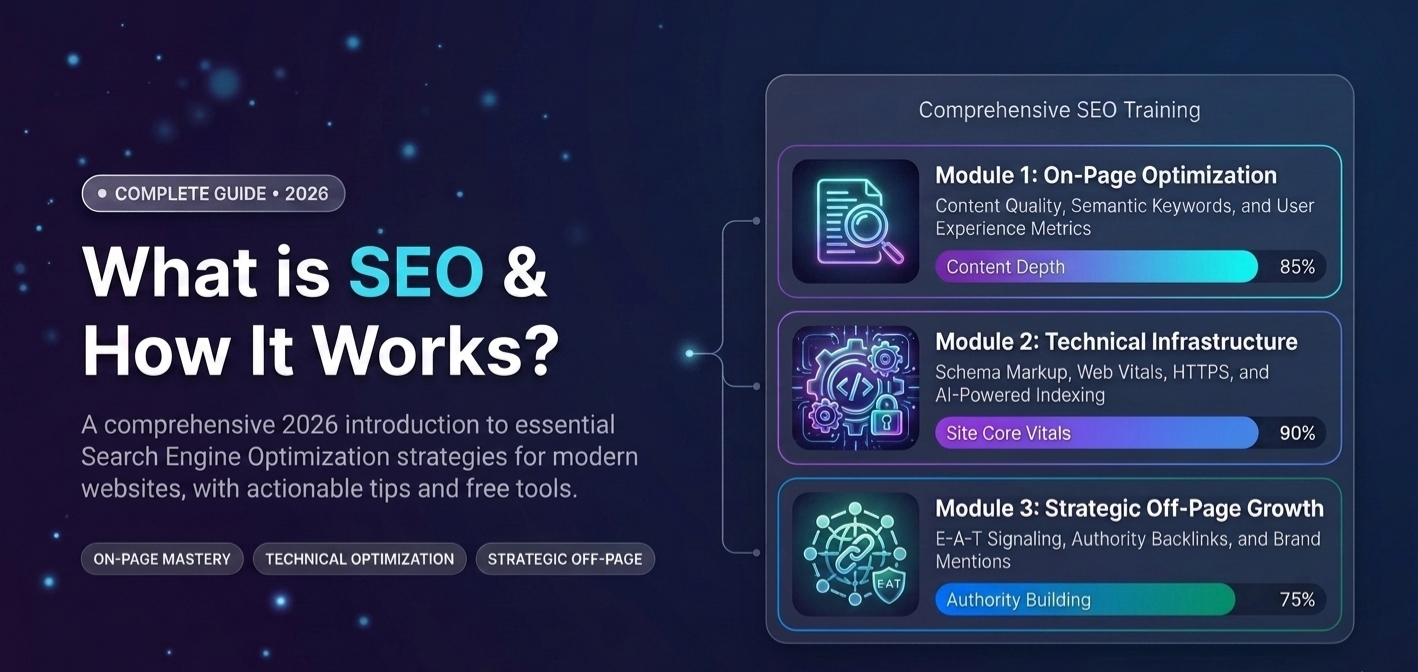
What is SEO and How Does It Work? The Complete 2026 Guide
Learn what SEO is and how it works in 2026. Complete guide covering on-page, technical, and off-page SEO. Free tools included. No signup required.
Start Optimizing Your SEO →📖 Table of Contents
- 1. What is SEO?
- 2. Why SEO Matters in 2026
- 3. How Search Engines Work
- 4. The 3 Pillars of SEO
- 5. On-Page SEO: Optimizing Your Content
- 6. Technical SEO: The Foundation of Your Site
- 7. Off-Page SEO: Building Authority
- 8. How to Measure Your SEO Performance
- 9. Common SEO Mistakes to Avoid
- 10. SEO Timeline: What to Expect
- 11. Frequently Asked Questions
1. What is SEO?
SEO (Search Engine Optimization) is the process of improving your website so that it appears higher in search engine results pages (SERPs) when people search for topics related to your content, products, or services.
The key word here is organic — SEO is about earning your position in search results, not paying for it. Unlike paid ads that disappear the moment you stop spending money, a well-optimized page can generate free traffic for months or even years.
Think of it this way: Google is essentially a library, and SEO is how you make sure your book ends up in the right section, with the right title, so that when someone asks the librarian for a recommendation, your book is the first one they pull out.
💡 The Simple Version
Every day, billions of people type questions into Google. Each of these searches is an opportunity. If your website has the best answer to these questions, Google will show it first. SEO is the process of making sure Google recognizes your content as the best answer.
2. Why SEO Matters in 2026
The digital landscape in 2026 is more competitive than ever, but the opportunity is also bigger than ever. Here's why SEO should be at the top of your priority list:
- Organic search drives the majority of web traffic. Studies consistently show that organic search results receive significantly more clicks than paid advertisements.
- The cost advantage is enormous. A well-optimized page that ranks on page one delivers free traffic every single day. SEO compounds over time — the effort you put in today keeps paying dividends for years.
- Trust and credibility. When your website appears at the top of search results, users naturally assume you're an authority in your field.
- The AI search revolution. In 2026, AI-powered search features like Google's AI Overviews pull information directly from well-optimized, authoritative pages.
- Mobile is everything. With the majority of searches now happening on mobile devices, Google has fully committed to mobile-first indexing.
3. How Search Engines Work
Before you can optimize your website, you need to understand what you're optimizing for. Search engines like Google follow a three-step process to deliver results:
Step 1: Crawling
Google uses automated programs called "crawlers" or "spiders" (Googlebot being the most famous) to continuously browse the web. These bots follow links from page to page, discovering new content and revisiting existing pages to check for updates.
Crawling is how Google finds your website. If your site is difficult to crawl — due to broken links, poor navigation structure, or a badly configured robots.txt file — Google may miss important pages entirely.
Step 2: Indexing
Once Google crawls a page, it analyzes the content and stores it in its massive database called the Index. Think of the index as Google's version of the card catalog in a library — it contains a record of every page Google knows about, along with information about what each page is about.
A page that isn't in Google's index simply cannot rank. Period.
Step 3: Ranking
This is where the magic happens — and where SEO comes in. When a user types a query into Google, the search engine's algorithm evaluates its entire index to determine which pages best answer that query. It then ranks those pages from most relevant and authoritative to least.
Google's ranking algorithm considers hundreds of factors, including: Relevance, Authority, User experience, Content quality, and Freshness.
4. The 3 Pillars of SEO
SEO can be broken down into three distinct categories:
- On-Page SEO — Optimizing the content and structure of your individual pages
- Technical SEO — Ensuring your website's infrastructure is search-engine friendly
- Off-Page SEO — Building your website's authority through external signals
5. On-Page SEO: Optimizing Your Content
On-page SEO refers to everything you do directly on your web pages to make them more relevant and useful to both users and search engines. It's the most direct form of SEO — you have complete control over it.
Keyword Research: The Foundation of Everything
Keywords are the words and phrases people type into search engines. There are two main types:
- Short-tail keywords are broad, high-volume terms like "SEO tools" or "DNS lookup." They have massive search volumes but are also extremely competitive.
- Long-tail keywords are more specific phrases like "how to check dns records for my domain" or "free ssl certificate expiry checker." They have lower search volumes individually, but they're far less competitive and convert better.
Keyword placement best practices:
- Include your primary keyword in the page title (H1 tag)
- Use the keyword naturally in the first 100 words of your content
- Include the keyword in your meta title and meta description
- Use the keyword in at least one subheading (H2 or H3)
- Include variations and related terms throughout the content
Check your meta tags: Use our Meta Tags Checker to see exactly how your page appears in Google search results.
Writing Content That Ranks
Great content is the single most important on-page SEO factor. Google evaluates content through the lens of E-E-A-T: Experience, Expertise, Authoritativeness, and Trustworthiness.
For practical purposes, this means your content should:
- Be comprehensive. Don't skim the surface. Answer the user's question completely.
- Be accurate and well-researched. Support your claims with data, examples, and evidence.
- Be original. Never copy content from other websites.
- Be updated. Outdated information damages your E-E-A-T.
- Be readable. Use short paragraphs, subheadings, bullet points, and images.
Title Tags and Meta Descriptions
Your title tag is the headline that appears in Google search results. Best practices: Keep them under 60 characters, include your primary keyword, and make every title unique.
Your meta description is the short paragraph that appears below the title. Best practices: Keep them between 150-160 characters, include your primary keyword, and write it like an advertisement.
Image Optimization
- File names matter. Use descriptive, keyword-rich names like "dns-lookup-tool-results.jpg."
- Alt text is essential. Every image should have a concise, descriptive alt text.
- File size affects speed. Always compress images before uploading.
Internal Linking
Internal links help Google discover pages and distribute "link equity." Best practice: whenever you publish a new page, look for opportunities to link to it from existing pages.
Check for broken internal links: Use our URL Redirect Checker to identify broken links and incorrect redirects across your website.
6. Technical SEO: The Foundation of Your Site
Technical SEO addresses the backend aspects of your website — the structural elements that determine how easily search engines can find, crawl, and understand your content.
Website Speed and Core Web Vitals
Google officially uses page experience signals, including Core Web Vitals, as ranking factors:
- Largest Contentful Paint (LCP): Target: under 2.5 seconds.
- Interaction to Next Paint (INP): Target: under 200 milliseconds.
- Cumulative Layout Shift (CLS): Target: below 0.1.
SSL Certificate (HTTPS)
HTTPS is a confirmed Google ranking factor. Check your SSL certificate: Use our SSL Lookup tool to instantly verify your certificate's validity, expiration date, and configuration.
Mobile-Friendliness
Google uses mobile-first indexing. Test your site on multiple screen sizes and pay attention to text readability, button size, loading speed, and no horizontal scrolling.
XML Sitemap
An XML sitemap helps Google discover and index your pages more efficiently. Your sitemap should only include pages you want Google to index.
Robots.txt
The robots.txt file tells search engine crawlers which parts of your site they should and shouldn't access.
DNS Configuration
Your DNS settings affect your site's availability, email deliverability, and security. Check your DNS records: Use our DNS Lookup tool to instantly query all DNS records for any domain.
URL Structure
Clean, descriptive URLs are better for both users and search engines. Use hyphens, keep URLs short, include your primary keyword, and avoid unnecessary parameters.
Canonical Tags
A canonical tag tells Google which version of a URL is the "official" one, preventing duplicate content issues.
Structured Data (Schema Markup)
Schema markup helps Google understand your content more precisely. Common schema types: Article, FAQPage, BreadcrumbList, WebSite.
7. Off-Page SEO: Building Authority
Off-page SEO refers to everything that happens outside your website that influences your rankings. The most important off-page signal is backlinks — links from other websites to yours.
Why Backlinks Matter
Think of backlinks as votes of confidence. When a reputable website links to your content, it's essentially telling Google: "This page is trustworthy and valuable."
What Makes a Backlink Valuable?
- Domain Authority: Links from high-authority sites carry more weight.
- Relevance: A link from an SEO blog to an SEO tool is far more valuable than a link from a cooking website.
- Link Placement: Links embedded naturally within the body text are more valuable.
- Anchor Text: Relevant anchor text adds additional SEO value.
- Dofollow vs. Nofollow: Dofollow links pass ranking authority.
How to Build Quality Backlinks
- Create link-worthy content. The best backlink strategy starts with creating content so valuable that other websites naturally want to reference it.
- Guest posting. Write articles for other reputable websites in your industry.
- Business directories. Listing your website on reputable directories builds foundational backlinks.
- Broken link building. Find broken URLs and offer your content as a replacement.
- Competitor analysis. Look at who's linking to your competitors and reach out to those same sites.
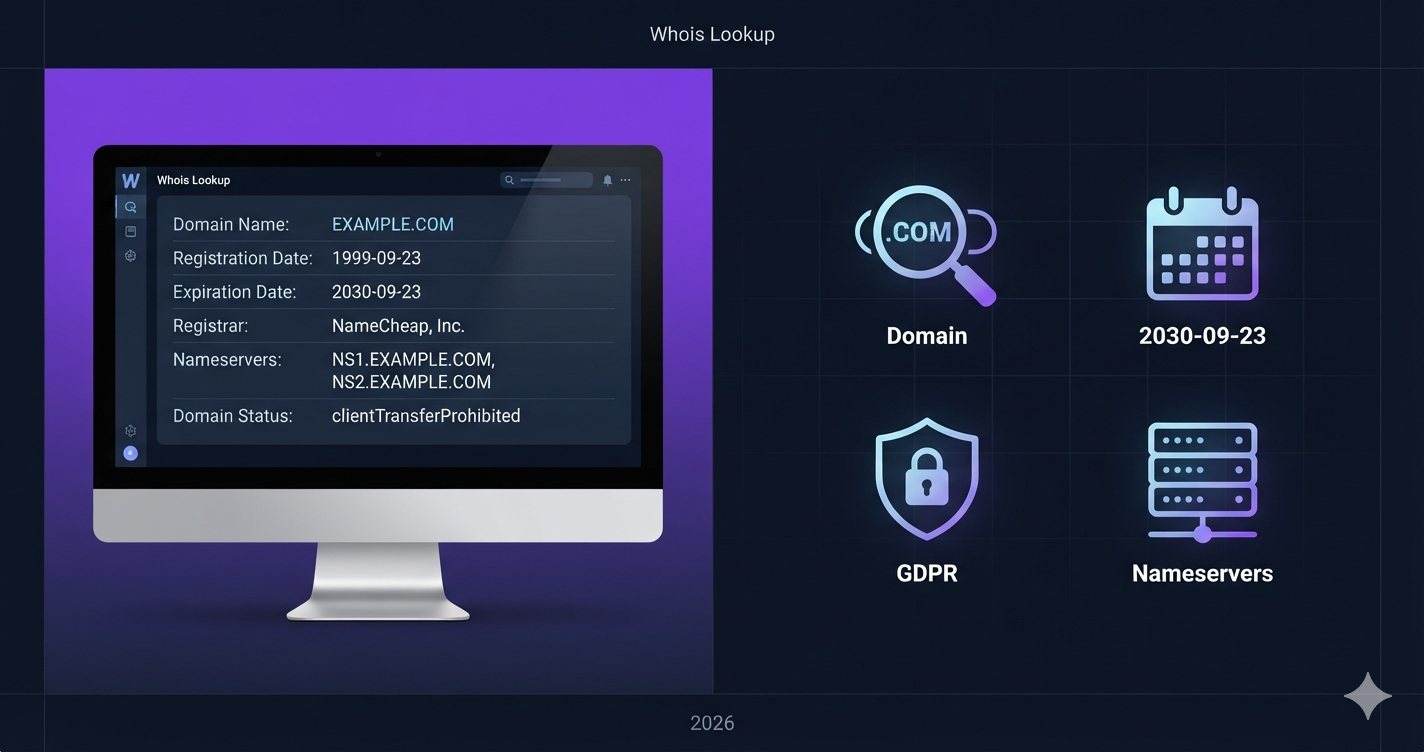
Check domain information: Use our Whois Lookup to check domain registration details, age, and ownership information.
8. How to Measure Your SEO Performance
You can't improve what you don't measure. Key metrics to track:
- Google Search Console — Impressions, clicks, average position, click-through rate (CTR), index coverage
- Organic Traffic — Visitors who arrived by clicking an unpaid search result
- Keyword Rankings — Where your pages appear for specific keywords
- Domain Authority (DA) — Score predicting how likely a website is to rank
- Bounce Rate — Percentage of visitors who leave after viewing only one page
- Backlink Profile — The total set of links pointing to your website
9. Common SEO Mistakes to Avoid
- Targeting keywords that are too competitive. Start with long-tail keywords and build your way up.
- Ignoring technical issues. A slow page, broken links, or a misconfigured robots.txt can silently undermine all your content efforts.
- Creating thin content. Short, surface-level content rarely ranks.
- Keyword stuffing. Write naturally, for humans first.
- Not optimizing for mobile. A poor mobile experience directly harms your rankings.
- Ignoring internal linking. Internal links are one of the easiest on-page wins available.
- Expecting instant results. SEO is a long game. Patience and consistency are non-negotiable.
- Building low-quality backlinks. Focus on quality over quantity.
- Neglecting to update old content. Outdated information signals poor quality to Google.
- Duplicate content. Use canonical tags and consolidate duplicate content.
10. SEO Timeline: What to Expect
The First 3 Months: Foundation Building
- Google discovers and indexes your pages
- Your new domain begins to accumulate credibility
- Long-tail content may begin appearing in search results
- Impressions in Google Search Console start rising
Months 3-6: Early Momentum
- Some long-tail keyword articles reach page 2-3 of Google
- Organic clicks begin, even if modest
- Backlinks from directories and early outreach efforts start to take effect
Months 6-12: Growth Phase
- Several articles rank in the top 10 for their target keywords
- Organic traffic grows month over month
- The compounding effect of backlinks and content begins to show
Year 1 and Beyond: Compounding Returns
SEO's greatest advantage is that its benefits compound over time. After 12-18 months of consistent effort, a well-executed SEO strategy can become one of your primary sources of traffic — for free.
11. Frequently Asked Questions
SEO typically takes 3 to 6 months before you see meaningful organic traffic, and 6 to 18 months to see significant results.
The organic traffic that SEO generates is free. However, there are costs involved in SEO itself: content creation, SEO tools (though many are free), and potentially link building outreach.
SEO focuses on earning organic, unpaid rankings. SEM (Search Engine Marketing) includes both SEO and paid search advertising (like Google Ads).
Social media is not a direct ranking factor, but it can indirectly support SEO by increasing visibility and driving traffic.
It's far better to publish one thoroughly researched article per week than five thin, rushed pieces.
Domain Authority (DA) predicts how likely a website is to rank. You improve DA by earning high-quality backlinks from reputable websites.
Absolutely. The fundamentals can all be learned and executed independently using free tools like Google Search Console and Rankcept.
Content quality. Google's mission is to deliver the most helpful, accurate, and relevant information to users.
Ready to Put This into Practice?
Explore Rankcept's free tools — no sign-up required.
🚀 Start Optimizing Your SEO →Disclaimer: This guide is for educational purposes. SEO results vary based on competition, industry, and content quality.